
If you have been following the news lately, you might have heard about the planned flotilla to break the Israeli blockade of Gaza. Yesterday, the flotilla made good on its word to proceed, and the Israelis made good on their word to stop them from illegally entering Israeli territory.
The activists, who claimed to have peaceful intentions, reacted violently to the boarding of their ships by Israeli special forces. Many attacked the Israelis with metal pipes, some with mace and even knives. The Israeli forces boarded the ships, but left 9 activists dead and tens more injured. See first hand footage of the Israelis boarding the ship and being met with violent resistance.
Read More......
Monday, May 31, 2010

Friday, May 28, 2010
Only We Can Make Fun of Ourselves
I know, you come to the St. Lou Jew looking for insight into being a Jewish young adult in St. Louis and you just get a youtube video. If it makes you feel any better, it isn't just any video. It happens to be a great video from Israel (with English subtitles). In a style described as the 'SNL Oh Really' of Israel, the reporters cover some of Israel's biggest issues in a way that calls out the sheer absurdity of it all. Check it out!
Read More......
Read More......
Monday, May 24, 2010
Press Coverage in the Huffington Post
Looks like Next Dor isn't the only game in town getting some great press coverage. We were recently tipped off to this great story in the Huffington Post about Aaron Woolf, which cites our interview with the documentary film maker.
Click here to read the full HuffPo article, and here to read our full interview Read More......
Click here to read the full HuffPo article, and here to read our full interview Read More......
Monday, May 17, 2010
This week in the Lou
So you looked into your magic 8-ball and it came up cloudy for the week... never fear, The St. Lou Jew is here to make sure you know what is happening in St. Louis
Here is some light reading before we jump in about why young Jews don't affiliate and the failure of the American Jewish Establishment (our favorite discussions topics).
Now on to the main events:
Tonight, be sure to catch Aaron Woolf's new film, entitled "Beyond Motor City" which is making its local debut at the Tivoli tonight at 7 PM. Aaron will be in the house along with Congressman Russ Carnahan, so be sure to stop in and meet them.
Tomorrow, catch Twilight Tuesdays at the History Museum followed by Shavuot, which pops off with Yoga at the Next Dor House, headlined by a brief prayer by Rabbi Susan Talve at 8 PM.
On Wednesday, TriYoga will be at Next Dor at 6:45, with Moise House holding a Movie night at 7:30.
Thursday, Autiomadic will be performing with the Hood Internet at the Gramophone. Show up early for free PBR.
Friday, 3rd Friday's is back at Next Dor, bringing a meal fit for a king at a price fit for a pauper (free!). This month, Melody from AIPAC will be in the house to talk about her work. More information here
As if you didn't already have enough to do, right?
Read More......
Here is some light reading before we jump in about why young Jews don't affiliate and the failure of the American Jewish Establishment (our favorite discussions topics).
Now on to the main events:
Tonight, be sure to catch Aaron Woolf's new film, entitled "Beyond Motor City" which is making its local debut at the Tivoli tonight at 7 PM. Aaron will be in the house along with Congressman Russ Carnahan, so be sure to stop in and meet them.
Tomorrow, catch Twilight Tuesdays at the History Museum followed by Shavuot, which pops off with Yoga at the Next Dor House, headlined by a brief prayer by Rabbi Susan Talve at 8 PM.
On Wednesday, TriYoga will be at Next Dor at 6:45, with Moise House holding a Movie night at 7:30.
Thursday, Autiomadic will be performing with the Hood Internet at the Gramophone. Show up early for free PBR.
Friday, 3rd Friday's is back at Next Dor, bringing a meal fit for a king at a price fit for a pauper (free!). This month, Melody from AIPAC will be in the house to talk about her work. More information here
As if you didn't already have enough to do, right?
Read More......
Thursday, May 13, 2010
How's Your Thursday Shaping Up?
Trying to figure out what is going on tonight? Maybe you are looking for some mental stimulation, or just want to hear some great music. Not to worry, the St. Lou Jew has you covered!
Tonight, the St. Louis Israel Connection's Israeli Film Series continues with Waltz With Bashir, the internationally acclaimed movie dealing with the director's search for memory and meaning in the events of the Lebanon war and Massacres in the Sabra and Shattila refugee camps.
The film contains adult and graphic content, so note you've been warned. Here is the info: 6:45pm @ the Holocaust Museum, 12 Millstone Campus Drive St. Louis MO 63146
If you are in the mood for something a bit less heavy, make sure to get over to the City Museum and check out Midwest Mayhem for dancers, DJs, food, drink, and 12 bands on four stages. Make sure to be there for the FUnky Butt Brass Band.
You have no excuse to sit at home alone tonight. If you don't know, now you know.
Read More......
Tonight, the St. Louis Israel Connection's Israeli Film Series continues with Waltz With Bashir, the internationally acclaimed movie dealing with the director's search for memory and meaning in the events of the Lebanon war and Massacres in the Sabra and Shattila refugee camps.
Waltz with Bashir is an astonishing work of art that sets fire to the deep human questions emerging from contemporary Israel. Israel's Ari Folman tries to wrap his head around 1982's Lebanon War (the title refers to Lebanese leader Bashir Gemayel). Why do disturbing dreams plague his former army colleagues, while he remembers nothing? Folman meets with nine of them to find out.
The film contains adult and graphic content, so note you've been warned. Here is the info: 6:45pm @ the Holocaust Museum, 12 Millstone Campus Drive St. Louis MO 63146
If you are in the mood for something a bit less heavy, make sure to get over to the City Museum and check out Midwest Mayhem for dancers, DJs, food, drink, and 12 bands on four stages. Make sure to be there for the FUnky Butt Brass Band.
You have no excuse to sit at home alone tonight. If you don't know, now you know.
Read More......
Wednesday, May 12, 2010
JAPS on TV... Jewsey Shore?
Two signs of the apocalypse, Desperate Housewives and Jersey Shore are two of the most popular shows on TV. So how could it get any worse? By combining the two of them into a show about Jewish American Princesses.
Oh yea, it's that bad. According to a story on Radar Online, "An email sent out by Get Some Media says “Production company looking for ‘Super Jappy’ groups of friends! Women ages 21 – 45 are able to apply for this reality show. Gone are the days where being a JAP is a bad thing – today Jewish American Princesses are proud.”"
This is exactly what our country needs! A way to show off super materialistic upper-crusters who are chosen because they are Jewish. I love a good set up.
So not only are we hurtling ourselves towards all-out class warfare, now we are opening the door for stereotypes and begging them to take flight.
Jezebel has already weighed in on the story, but I certainly hope that there are enough people out there who believe this idea to be complete crap that it never makes the light of daytime television (or any other time for that matter).
Read More......
Oh yea, it's that bad. According to a story on Radar Online, "An email sent out by Get Some Media says “Production company looking for ‘Super Jappy’ groups of friends! Women ages 21 – 45 are able to apply for this reality show. Gone are the days where being a JAP is a bad thing – today Jewish American Princesses are proud.”"
This is exactly what our country needs! A way to show off super materialistic upper-crusters who are chosen because they are Jewish. I love a good set up.
So not only are we hurtling ourselves towards all-out class warfare, now we are opening the door for stereotypes and begging them to take flight.
Jezebel has already weighed in on the story, but I certainly hope that there are enough people out there who believe this idea to be complete crap that it never makes the light of daytime television (or any other time for that matter).
Read More......
Tuesday, May 11, 2010
Let's Get Street (Car)
In the wake of the Metro Prop A win, and in anticipation of Aaron Woolf's visit conjunction with the debut of 'Beyond Motor City', it seems particularly pertinent to shout out Cincinnati for its progress on an urban street car line.
That's right, Cincinnati, the city that makes St. Louis look progressive on most issues, has taken major steps in bringing back the street car.
In moves that come right from the top levels of local government, a Cincinnati city council committee has recommended approval of $64 million in bonds to create a street car line. Not to say that they are going to make this happen overnight, but this shows that the city is really committed to making something happen. From the article:
Dear St. Louis... are you paying attention?
Read More......
That's right, Cincinnati, the city that makes St. Louis look progressive on most issues, has taken major steps in bringing back the street car.
In moves that come right from the top levels of local government, a Cincinnati city council committee has recommended approval of $64 million in bonds to create a street car line. Not to say that they are going to make this happen overnight, but this shows that the city is really committed to making something happen. From the article:
Most public speakers encouraged the council members to, after several years of often contentious review, forcefully move ahead on the streetcar project, which has become a political flashpoint inside and outside City Hall alternately seen as a linchpin of the city’s future or a symbol of ill-conceived government spending.
“The question isn’t whether we can afford to build the streetcar,” said David Cole of Westwood. “The question is whether we can afford not to.”
Dear St. Louis... are you paying attention?
Read More......
Friday, May 7, 2010
Review of Rabbi Akiva Tatz Talk at Next Dor
Last night, Rabbi Akiva Tatz, known for his talks, lectures and books covering a variety of Jewish subjects, spoke to 20 young adults about relationships and the idea of Jewish marriage
It is perhaps important to note the difference between the 'Jewish idea of marriage' as compared to 'the idea of Jewish marriage'. The subtle difference between the two is that the Jewish idea of marriage focuses on what a marriage provides, the relationship, the connection, etc., while the idea of a Jewish marriage focuses by definition on two Jews marrying for the purpose of creating a Jewish family. Follow me so far?
Rabbi Tatz began by laying out the non-negotiables for the basis of the marriage, that the relationship had to be between a man and a woman, that both partners must be Jewish (although a convert is 1000% Jewish, so long as they were converted in the Orthodox fashion).
He delved into some of the Kabbalistic understandings of marriage as the reunification of a single soul torn into two upon its journey from the spiritual to the physical world.
Rabbi Tatz went on to speak about attraction/chemistry as the most important factor, followed by the person's character, and along the way provided examples of marriages that had worked out, or hadn't depending on these various items.
Now it is important to note that Rabbi Tatz, although not born religious, is now quite religious, and is fairly black and white in regards to right and wrong ways to do things Jewishly. This made his comments all the most interesting when considering that his audience was composed of a mixed crowd of both fully secular and more religious Jews.
Rabbi Tatz did recognize that, while in religious communities, being set up with a wife without knowing her can work, that it is necessary to spend more time getting to know a potential partner in the secular world.
He raised a point almost totally foreign in the secular world. "How do you know when it is time to get engaged or call it off?" he asked. "When you know that one more date with the person will not reveal any new information." That is to say that once you know everything you need to know to make the decision, it is time to make it.
This runs fully counter to the flow of the secular world, in which people are often not considering marriage (particularly early on) during dating. For Rabbi Tatz and the Orthodox world, why date if you aren't moving specifically towards marriage?
The conversation was certainly an interesting one and brought up, in true Jewish fashion, more questions than answers. To learn more about Rabbi Akiva Tatz, please click here
Read More......
It is perhaps important to note the difference between the 'Jewish idea of marriage' as compared to 'the idea of Jewish marriage'. The subtle difference between the two is that the Jewish idea of marriage focuses on what a marriage provides, the relationship, the connection, etc., while the idea of a Jewish marriage focuses by definition on two Jews marrying for the purpose of creating a Jewish family. Follow me so far?
Rabbi Tatz began by laying out the non-negotiables for the basis of the marriage, that the relationship had to be between a man and a woman, that both partners must be Jewish (although a convert is 1000% Jewish, so long as they were converted in the Orthodox fashion).
He delved into some of the Kabbalistic understandings of marriage as the reunification of a single soul torn into two upon its journey from the spiritual to the physical world.
Rabbi Tatz went on to speak about attraction/chemistry as the most important factor, followed by the person's character, and along the way provided examples of marriages that had worked out, or hadn't depending on these various items.
Now it is important to note that Rabbi Tatz, although not born religious, is now quite religious, and is fairly black and white in regards to right and wrong ways to do things Jewishly. This made his comments all the most interesting when considering that his audience was composed of a mixed crowd of both fully secular and more religious Jews.
Rabbi Tatz did recognize that, while in religious communities, being set up with a wife without knowing her can work, that it is necessary to spend more time getting to know a potential partner in the secular world.
He raised a point almost totally foreign in the secular world. "How do you know when it is time to get engaged or call it off?" he asked. "When you know that one more date with the person will not reveal any new information." That is to say that once you know everything you need to know to make the decision, it is time to make it.
This runs fully counter to the flow of the secular world, in which people are often not considering marriage (particularly early on) during dating. For Rabbi Tatz and the Orthodox world, why date if you aren't moving specifically towards marriage?
The conversation was certainly an interesting one and brought up, in true Jewish fashion, more questions than answers. To learn more about Rabbi Akiva Tatz, please click here
Read More......
Wednesday, May 5, 2010
Aaron Woolf: Director of Beyond Motor City
Aaron Woolf is a documentary filmmaker is best known for King Corn, which looks at the complex outcomes of our country’s decision to heavily subsidize the production of corn. His new film, called Beyond Motor City, takes Aaron’s incisive ability to understand interacting systems and present them in a digestible way through the medium of film.
We had a chance to speak with Aaron in anticipation of the St. Louis debut of Beyond Motor City (May 17th at the Tivoli at 7 PM). Check out what the man has to say!
The St. Lou Jew:
You have spent a lot of time looking into agricultural systems, particularly the Corn Industry, and focused a lot on local agriculture. How did you make the jump from that into looking at transportation?
Aaron Woolf:
It is actually not that huge of a leap. After making King Corn, I became really interested in the nuts and bolts of local and regional food economies so I opened a small grocery store focused on local products (in Brooklyn) to see what the challenges really are. The bottleneck in the adoption of local and organic foods isn’t lack of demand...or even supply. In fact, arable lands near big cities are the some of the only places where we’re seeing a lot of young people returning to agriculture. It is the infrastructure [of getting the food to market] that’s lacking.
We played around with the idea of listing the carbon footprint of everything in our store, but found that the truth is that a kiwi from New Zealand can have a smaller carbon footprint than an organic tomato from New Jersey, which has a lot to do with the systems of getting these items from one place to another.
So I became interested in understanding how these systems, rail and highway, get built.
It turns out that, in terms of a national vision for transportation, America has radically transformed itself before...but really only once in a generation. I think we are at that point in our generation where we can once again transform.
STLJew: How did you settle on Detroit as the focal point of this film?
AW: I was initially interested in Detroit based on the vigorous local food movement there, but the more I looked at it, from a transportation and infrastructure standpoint, the more I saw the way that, historically, the city was so much more just the place we associate with the auto industry. Detroit has actually embodied each of the previous transportation chapters our nation has been through as well - from canals and rail through to the highway dominated system we have today.
In the early 19th century, Detroit went from being a sleepy outpost to a thriving river city due to the commerce created by the construction of the Erie Canal. It was an incredibly audacious act. Prior to that point, the longest canal in the US was 30 miles. The Erie Canal was a 300 mile project – and represented the can-do spirit of the new nation. It had a huge transformative effect. It is likely that without the Erie Canal, New Orleans would have eclipsed New York as the country’s premier port and economic capital. The entire outcome of the Civil War might have turned out differently!
When you examine the introduction of rail and highways systems in later epochs, you can see that Detroit was always at the vanguard. I would like to see an audacious investment in a 21st century transportation infrastructure take hold in Detroit again and I think it’s possible.
If Detroit could rethink transportation, as they have done before, they could create an new model for what a city could be. Detroit could turn the decay, isolation, and abandonment into an opportunity. By combining new transportation infrastructures and a renewed initiative to bring real manufacturing for a green economy back to America with urban agriculture in Detroit’s abandoned sectors, Detroit could recreate the urban model and possibly be the first major city to feed itself!
StLouJew: You mention the decay and abandonment that permeates Detroit. Just recently the government of Detroit just announced a plan to raze entire areas of the city. How did we get to this point of being so spread out that our cities are that unsustainable?
AW: I think we have improperly come to conflate the car with the idea of freedom in this country. It was easier to say that cars and freedom were connected when oil was $11 a barrel and before we began to feel so un-free on our myriad clogged highways. For far too long, public transit has come to be thought of as the transit of last resort. But what form will a 21st century transportation landscape take?
You know, I was born in 1964. I remember some time in elementary school a teacher told me that in my adult lifetime we would have the metric system and physical transportation based around jetpacks. We already had the technology… Well it turns out that teacher was way wrong on both counts.
Of course if “freedom”, as in freedom of movement, were our only objective, jetpacks would represent the ultimate in freedom. But they also take immense amounts of energy to operate. Maybe when, knowingly or unknowingly, we decided not to invest in jetpack technology, we actually made a responsible choice… maybe for once we didn’t go with the most reckless and excessive way of doing things.
In my parents’ generation, everyone wanted to move to the suburbs, in your generation we are seeing a yearning to be part of a dense urban community. Maybe there’s another kind of freedom in NOT having a car. We once imagined infrastructure in a way that would make us free, but that so called freedom is totally unsustainable.
StLouJew: When it comes to food, individuals have the ability to impact the market by voting with their purchases, with transportation, change often comes from the top down. How do we take the 30,000 foot view?
AW: Perhaps we will find our motivation from the sense of competitiveness with other countries. China, Japan, Brazil and Europe are all re-thinking their transportation systems based on a balanced and sustainable future. They’re taking the long-term view, even though transportation investment can be expensive in the short term.
But perhaps we can find some of the motivation to change by looking at our own history… Creating this idea of a new American system is a powerful idea. Abraham Lincoln was a protégé of Henry Clay, who based his political thought on just that, creating a “New American System” which was based in large part on investing in a national transportation infrastructure. This is how the legislation that gave birth to the transatlantic railroad got snuck in during the civil war.
Look at what the Chinese and Spanish are doing today. They have invested heavily in the infrastructure that is going to build the next economy. The Chinese have spent $350 billion over the past 10 years on building a high-speed rail infrastructure - to put this in perspective, note that Obama just signed an $8 billion high speed rail bill into law.
We have the technology to do what we want to do. But we have to be willing to make the physical planning choices necessary and we have to understand how these interlocking systems locally, regionally, and nationally connect. We need to think long-term and think through the consequences of our choices.
In the realm of agriculture, I don’t think Earl Butz - who set us on a course of all out corn production - was “Doctor Evil” but his policies stressed productivity above all other considerations like environment and health and now we’re dealing with the unintended consequences. I don’t think Henry Ford thought cars would contribute to the disintegration of our communities. He thought he was democratizing transportation, but at the dawn of the 21st century we can see that our unbalanced emphasis on car-centered transportation has really helped remove people from each other -- and ironically has contributed in places like Detroit to a decaying sense of community. I really feel like we need to look at history to know how to move forward. That’s why we focus on that so much in the movie.
We are at a pivotal point in history, and in the world today we have countries who are hungry and willing to do what it takes to build their communities. Our greatest strength in this country is our diverse communities and our incredible reserve of human resources. But building a transportation infrastructure that supports human interaction and becomes a foundation for enterprise is prerequisite to taking full advantage of those resources.
We have the opportunity as a nation to meet that challenge. I think there are seeds of it almost everywhere in the country right now - not least of all in Detroit. Detroit is a place that has ridden the highest highs and the lowest lows of our national transportation choices. I believe the city can once again lead us toward a new vision. But it’s a conversation we need to have now.
Take the next step in the conversation, see the movie and meet Aaron on May 17 at the Tivoli!
Read More......
We had a chance to speak with Aaron in anticipation of the St. Louis debut of Beyond Motor City (May 17th at the Tivoli at 7 PM). Check out what the man has to say!
The St. Lou Jew:
You have spent a lot of time looking into agricultural systems, particularly the Corn Industry, and focused a lot on local agriculture. How did you make the jump from that into looking at transportation?
Aaron Woolf:
It is actually not that huge of a leap. After making King Corn, I became really interested in the nuts and bolts of local and regional food economies so I opened a small grocery store focused on local products (in Brooklyn) to see what the challenges really are. The bottleneck in the adoption of local and organic foods isn’t lack of demand...or even supply. In fact, arable lands near big cities are the some of the only places where we’re seeing a lot of young people returning to agriculture. It is the infrastructure [of getting the food to market] that’s lacking.
We played around with the idea of listing the carbon footprint of everything in our store, but found that the truth is that a kiwi from New Zealand can have a smaller carbon footprint than an organic tomato from New Jersey, which has a lot to do with the systems of getting these items from one place to another.
So I became interested in understanding how these systems, rail and highway, get built.
It turns out that, in terms of a national vision for transportation, America has radically transformed itself before...but really only once in a generation. I think we are at that point in our generation where we can once again transform.
STLJew: How did you settle on Detroit as the focal point of this film?
AW: I was initially interested in Detroit based on the vigorous local food movement there, but the more I looked at it, from a transportation and infrastructure standpoint, the more I saw the way that, historically, the city was so much more just the place we associate with the auto industry. Detroit has actually embodied each of the previous transportation chapters our nation has been through as well - from canals and rail through to the highway dominated system we have today.
In the early 19th century, Detroit went from being a sleepy outpost to a thriving river city due to the commerce created by the construction of the Erie Canal. It was an incredibly audacious act. Prior to that point, the longest canal in the US was 30 miles. The Erie Canal was a 300 mile project – and represented the can-do spirit of the new nation. It had a huge transformative effect. It is likely that without the Erie Canal, New Orleans would have eclipsed New York as the country’s premier port and economic capital. The entire outcome of the Civil War might have turned out differently!
When you examine the introduction of rail and highways systems in later epochs, you can see that Detroit was always at the vanguard. I would like to see an audacious investment in a 21st century transportation infrastructure take hold in Detroit again and I think it’s possible.
If Detroit could rethink transportation, as they have done before, they could create an new model for what a city could be. Detroit could turn the decay, isolation, and abandonment into an opportunity. By combining new transportation infrastructures and a renewed initiative to bring real manufacturing for a green economy back to America with urban agriculture in Detroit’s abandoned sectors, Detroit could recreate the urban model and possibly be the first major city to feed itself!
StLouJew: You mention the decay and abandonment that permeates Detroit. Just recently the government of Detroit just announced a plan to raze entire areas of the city. How did we get to this point of being so spread out that our cities are that unsustainable?
AW: I think we have improperly come to conflate the car with the idea of freedom in this country. It was easier to say that cars and freedom were connected when oil was $11 a barrel and before we began to feel so un-free on our myriad clogged highways. For far too long, public transit has come to be thought of as the transit of last resort. But what form will a 21st century transportation landscape take?
You know, I was born in 1964. I remember some time in elementary school a teacher told me that in my adult lifetime we would have the metric system and physical transportation based around jetpacks. We already had the technology… Well it turns out that teacher was way wrong on both counts.
Of course if “freedom”, as in freedom of movement, were our only objective, jetpacks would represent the ultimate in freedom. But they also take immense amounts of energy to operate. Maybe when, knowingly or unknowingly, we decided not to invest in jetpack technology, we actually made a responsible choice… maybe for once we didn’t go with the most reckless and excessive way of doing things.
In my parents’ generation, everyone wanted to move to the suburbs, in your generation we are seeing a yearning to be part of a dense urban community. Maybe there’s another kind of freedom in NOT having a car. We once imagined infrastructure in a way that would make us free, but that so called freedom is totally unsustainable.
StLouJew: When it comes to food, individuals have the ability to impact the market by voting with their purchases, with transportation, change often comes from the top down. How do we take the 30,000 foot view?
AW: Perhaps we will find our motivation from the sense of competitiveness with other countries. China, Japan, Brazil and Europe are all re-thinking their transportation systems based on a balanced and sustainable future. They’re taking the long-term view, even though transportation investment can be expensive in the short term.
But perhaps we can find some of the motivation to change by looking at our own history… Creating this idea of a new American system is a powerful idea. Abraham Lincoln was a protégé of Henry Clay, who based his political thought on just that, creating a “New American System” which was based in large part on investing in a national transportation infrastructure. This is how the legislation that gave birth to the transatlantic railroad got snuck in during the civil war.
Look at what the Chinese and Spanish are doing today. They have invested heavily in the infrastructure that is going to build the next economy. The Chinese have spent $350 billion over the past 10 years on building a high-speed rail infrastructure - to put this in perspective, note that Obama just signed an $8 billion high speed rail bill into law.
We have the technology to do what we want to do. But we have to be willing to make the physical planning choices necessary and we have to understand how these interlocking systems locally, regionally, and nationally connect. We need to think long-term and think through the consequences of our choices.
In the realm of agriculture, I don’t think Earl Butz - who set us on a course of all out corn production - was “Doctor Evil” but his policies stressed productivity above all other considerations like environment and health and now we’re dealing with the unintended consequences. I don’t think Henry Ford thought cars would contribute to the disintegration of our communities. He thought he was democratizing transportation, but at the dawn of the 21st century we can see that our unbalanced emphasis on car-centered transportation has really helped remove people from each other -- and ironically has contributed in places like Detroit to a decaying sense of community. I really feel like we need to look at history to know how to move forward. That’s why we focus on that so much in the movie.
We are at a pivotal point in history, and in the world today we have countries who are hungry and willing to do what it takes to build their communities. Our greatest strength in this country is our diverse communities and our incredible reserve of human resources. But building a transportation infrastructure that supports human interaction and becomes a foundation for enterprise is prerequisite to taking full advantage of those resources.
We have the opportunity as a nation to meet that challenge. I think there are seeds of it almost everywhere in the country right now - not least of all in Detroit. Detroit is a place that has ridden the highest highs and the lowest lows of our national transportation choices. I believe the city can once again lead us toward a new vision. But it’s a conversation we need to have now.
Take the next step in the conversation, see the movie and meet Aaron on May 17 at the Tivoli!
Read More......
Monday, May 3, 2010
International Speaker and Author Dr. Akiva Tatz in St. Louis
It's not everyday that you get to hear a renowned (and famous) person speak (for free), just some days, and that day this week is Thursday.
Rabbi Akiva Tatz has spoken all over the world on topics such as Jewish medical ethics, relationships, finding one's purpose in life.
Wikipedia has the following to say about Rabbi Tatz:
To learn more about the event, please click here
Read More......
Rabbi Akiva Tatz has spoken all over the world on topics such as Jewish medical ethics, relationships, finding one's purpose in life.
Wikipedia has the following to say about Rabbi Tatz:
Rabbi Tatz gives lectures to Jewish student groups and organisations across the UK, including an annual medical ethics lecture at University College London hosted by both the Jewish Society and Medical Ethics Society. He is also a regular lecturer on the Jewish Learning Exchange Genesis leadership programme. He has become a recognized expert in matters of Jewish thought and philosophy, which he covers in his authored texts. Zoketsu Norman Fischer, former abbot of the San Francisco Zen Center and founder of and teacher at the Everyday Zen Foundation, describes Tatz's work, Letters to a Buddhist Jew, as "a fascinating book - the most serious contribution in this field to date."
Tatz is both the founder and director of the Jerusalem Medical Ethics Forum, whose purpose is to promote knowledge of Jewish medical ethics internationally, giving lectures worldwide[9] in Jewish thought and medical ethics, as well as on modern applications in medicine.[10] He is also involved with the Jerusalem Center for Research in Medicine and Halacha, often speaking at their annual European events.
To learn more about the event, please click here
Read More......
Friday, April 30, 2010
St. Lou Jews & How Prop A Came Together
"Nice Idea, But We Can't Afford It"
That sums up what Batya Abramson-Goldstein, Executive Director of the Jewish Community Relations Council (JCRC) of St. Louis, expected to hear from the voters of St. Louis County when they were asked this year to invest in Metrolink with a half-cent sales tax hike.
Proposition A, as it was called, instead passed with a comfortable margin, almost sixty-three percent of the vote.
 "That's a remarkable showing in the middle of a bad economic climate," says my friend Larry Handlin, a local political junkie and blogger. Tax initiatives had been soundly beaten twice before, most recently just in 2008, when fifty-two percent of St. Louis County voters said "no."
"A Vote of No Confidence"
Tom Shrout, Executive Director of Citizens for Modern Transit, spent a good part of 2008 in frustration. The campaign for Proposition M, that year's sales tax hike, was being run by a staff member in the office of County Executive Charlie Dooley, and its message was mostly about how Metrolink needed more money.
 That was unfortunate, since tales of perceived overspending and mismanagement by Metrolink had been grabbing headlines for much of the year.
Many had assumed Prop M would pass, but looking back, the outcome was pretty predictable.
"What happened at the ballot box was a vote of no confidence," explains Batya Abramson-Goldstein.
But even before the Prop M vote in 2008, Tom Shrout had been part of a group that started putting together a coalition, the Greater St. Louis Transit Alliance, that kept working, kept meeting, kept reaching out.
 The JCRC was part of the effort all along but radically stepped up its game as well, holding community forums and building advocacy as early as March of 2009.
The Secret Is in the Sauce
Jews are as prominent in St. Louis public transit issues as we are in most other areas of civic engagement. Maybe more so. Going back decades, some prominent names are those of former Clayton mayor Ben Uchitelle (who I study Torah with at Central Reform Congregation), or Les Sterman, head of the East-West Gateway Council of Governments, or Fred Epstein, part of the leadership of the Greater St. Louis Transit Alliance.
But from the start of the campaign for Prop A, even before anyone knew which letter it would have, the Jewish organizing machine seemed to go into overdrive.
Tom Shrout recalls that Bob Baer, Metro's President and CEO, reached out to Jewish organizations as far back as December of 2008, leading to a meeting with over forty people that focused on the implications of losing mass transit for less fortunate people.
Four months later, the JCRC put together a community forum that drew almost two hundred people, more than a year before election day.
"The bus lines were being closed down," Abramson-Goldstein recalls. "We had a couple who live in a nursing home, and they were no longer able to get to their synagogue let alone other activities. There was a blind woman, President of a state organization, who was completely dependent on Metrolink. There was a young Muslim man unable to get to work or his mosque."
"It was a community concern," she concludes. "A social justice concern. The whole community was affected, and the issue resonated on all those levels."
Jewish volunteers and organizations networked with labor unions, social welfare organizations, African-American churches, and disability advocates such as the Missouri Organization for the Blind. The editorial board of the Jewish Light prodded the community with strong endorsements. A massive absentee ballot effort was launched to enable observant County residents to cast their votes on election day, April 6th, which fell on a Yom Tov, the eighth day of Passover.
It All Came Together. And How.
Numerically, the differences between 2008 and 2010 are eye-popping. In spite of the worst economic conditions in recent memory, supporters of Prop A delivered more votes in almost every precinct.
But Tom Shrout saw one particular pattern right away.
"You saw a big turnaround in Olivette, Creve Coeur, and other parts of the region," he recalls, indicating areas with high proportions of Jewish voters.
"In those places, it was eighteen to twenty percentage points," he points out. "That's huge."
The St. Louis County Board of Elections crunched the numbers and came up with the images below, which you can see in greater detail here.
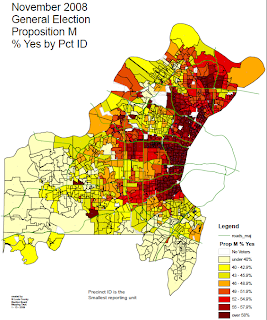
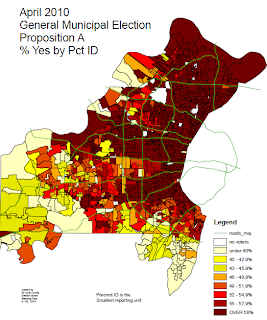
Overlay these maps with your minds-eye view of the Jewish geography of St. Louis, and you begin to see the picture.
"I Think It Shows the Power of Community."
In fairness, Prop A was carried by hefty margins in plenty of decidedly not Jewish precincts.
But all in all, the Jewish community arguably deserves a pat on the back for keeping the engine of transit running in St. Louis.
"I'm grateful to the Jewish community," says Tom Shrout. "I have been for twenty-two years."
Batya Abramson-Goldstein would certainly agree.
"It's terrific when the community comes together," she says.
Michael Getty is a freelance writer who blogs at almostjewish.wordpress.com and tweets at twitter.com/shimonides
Read More......
That sums up what Batya Abramson-Goldstein, Executive Director of the Jewish Community Relations Council (JCRC) of St. Louis, expected to hear from the voters of St. Louis County when they were asked this year to invest in Metrolink with a half-cent sales tax hike.
Proposition A, as it was called, instead passed with a comfortable margin, almost sixty-three percent of the vote.
 "That's a remarkable showing in the middle of a bad economic climate," says my friend Larry Handlin, a local political junkie and blogger. Tax initiatives had been soundly beaten twice before, most recently just in 2008, when fifty-two percent of St. Louis County voters said "no."
"A Vote of No Confidence"
Tom Shrout, Executive Director of Citizens for Modern Transit, spent a good part of 2008 in frustration. The campaign for Proposition M, that year's sales tax hike, was being run by a staff member in the office of County Executive Charlie Dooley, and its message was mostly about how Metrolink needed more money.
 That was unfortunate, since tales of perceived overspending and mismanagement by Metrolink had been grabbing headlines for much of the year.
Many had assumed Prop M would pass, but looking back, the outcome was pretty predictable.
"What happened at the ballot box was a vote of no confidence," explains Batya Abramson-Goldstein.
But even before the Prop M vote in 2008, Tom Shrout had been part of a group that started putting together a coalition, the Greater St. Louis Transit Alliance, that kept working, kept meeting, kept reaching out.
 The JCRC was part of the effort all along but radically stepped up its game as well, holding community forums and building advocacy as early as March of 2009.
The Secret Is in the Sauce
Jews are as prominent in St. Louis public transit issues as we are in most other areas of civic engagement. Maybe more so. Going back decades, some prominent names are those of former Clayton mayor Ben Uchitelle (who I study Torah with at Central Reform Congregation), or Les Sterman, head of the East-West Gateway Council of Governments, or Fred Epstein, part of the leadership of the Greater St. Louis Transit Alliance.
But from the start of the campaign for Prop A, even before anyone knew which letter it would have, the Jewish organizing machine seemed to go into overdrive.
Tom Shrout recalls that Bob Baer, Metro's President and CEO, reached out to Jewish organizations as far back as December of 2008, leading to a meeting with over forty people that focused on the implications of losing mass transit for less fortunate people.
Four months later, the JCRC put together a community forum that drew almost two hundred people, more than a year before election day.
"The bus lines were being closed down," Abramson-Goldstein recalls. "We had a couple who live in a nursing home, and they were no longer able to get to their synagogue let alone other activities. There was a blind woman, President of a state organization, who was completely dependent on Metrolink. There was a young Muslim man unable to get to work or his mosque."
"It was a community concern," she concludes. "A social justice concern. The whole community was affected, and the issue resonated on all those levels."
Jewish volunteers and organizations networked with labor unions, social welfare organizations, African-American churches, and disability advocates such as the Missouri Organization for the Blind. The editorial board of the Jewish Light prodded the community with strong endorsements. A massive absentee ballot effort was launched to enable observant County residents to cast their votes on election day, April 6th, which fell on a Yom Tov, the eighth day of Passover.
It All Came Together. And How.
Numerically, the differences between 2008 and 2010 are eye-popping. In spite of the worst economic conditions in recent memory, supporters of Prop A delivered more votes in almost every precinct.
But Tom Shrout saw one particular pattern right away.
"You saw a big turnaround in Olivette, Creve Coeur, and other parts of the region," he recalls, indicating areas with high proportions of Jewish voters.
"In those places, it was eighteen to twenty percentage points," he points out. "That's huge."
The St. Louis County Board of Elections crunched the numbers and came up with the images below, which you can see in greater detail here.


Overlay these maps with your minds-eye view of the Jewish geography of St. Louis, and you begin to see the picture.
"I Think It Shows the Power of Community."
In fairness, Prop A was carried by hefty margins in plenty of decidedly not Jewish precincts.
But all in all, the Jewish community arguably deserves a pat on the back for keeping the engine of transit running in St. Louis.
"I'm grateful to the Jewish community," says Tom Shrout. "I have been for twenty-two years."
Batya Abramson-Goldstein would certainly agree.
"It's terrific when the community comes together," she says.
Michael Getty is a freelance writer who blogs at almostjewish.wordpress.com and tweets at twitter.com/shimonides
Read More......
Monday, April 26, 2010
A Very Musical Week
Fresh off a packed Shabbat Dinner at Next Dor, and some ridiculous storms, The St. Lou Jew wants you to know about all of the great music taking place in St. Louis this week.
We'll get right to it. After an impromptu acoustic jam session at Next Dor last night, it dawned on us that there is a lot of music going on in and around STL this week.
Tuesday, Cincinnati based band Foxy Shazam will be tearing up Off Broadway
with a show that has earned it a Riverfront Times Critic Pick. Bonus points for having keyboard player Sky White, with whom I conquered the Bogart's High School Battle of the Bands back in the day.
Wednesday, while it may not quite be music, the Jewish Bikers club is having a meeting at the Hacienda on Manchester. I'm so intrigued by the concept, I may just have to check it out.
Thursday, slide on down to Beale on Broadway to check out one of St. Louis' own stars, Kim Massie as she performs your favorite soul and R&B tunes.
Friday, KDHX, St. Louis' own independent radio station will be hosting a tribute to James Brown at Off Broadway.
If you happen to be in Fayetteville, Arkansas on Friday, come check out STL's Autiomadic with Hardaway and the Commoners.
Saturday, Start off the evening with Chana Rothman, a newly crowned queen of Roots/Rock/Jewfolk music, who will be performing at Temple Emmanuel in the early evening. Following that, check out SLIC's Israeli Independence Day party. Cap off the night with a huge dance party at the Gramophone to make it a well balanced night.
Just announced, on Sunday, The Moshav Band, an Israeli-American group, will be performing for free at United Hebrew. More details here.
I told you it would be a busy week! Read More......
We'll get right to it. After an impromptu acoustic jam session at Next Dor last night, it dawned on us that there is a lot of music going on in and around STL this week.
Tuesday, Cincinnati based band Foxy Shazam will be tearing up Off Broadway
with a show that has earned it a Riverfront Times Critic Pick. Bonus points for having keyboard player Sky White, with whom I conquered the Bogart's High School Battle of the Bands back in the day.
Wednesday, while it may not quite be music, the Jewish Bikers club is having a meeting at the Hacienda on Manchester. I'm so intrigued by the concept, I may just have to check it out.
Thursday, slide on down to Beale on Broadway to check out one of St. Louis' own stars, Kim Massie as she performs your favorite soul and R&B tunes.
Friday, KDHX, St. Louis' own independent radio station will be hosting a tribute to James Brown at Off Broadway.
If you happen to be in Fayetteville, Arkansas on Friday, come check out STL's Autiomadic with Hardaway and the Commoners.
Saturday, Start off the evening with Chana Rothman, a newly crowned queen of Roots/Rock/Jewfolk music, who will be performing at Temple Emmanuel in the early evening. Following that, check out SLIC's Israeli Independence Day party. Cap off the night with a huge dance party at the Gramophone to make it a well balanced night.
Just announced, on Sunday, The Moshav Band, an Israeli-American group, will be performing for free at United Hebrew. More details here.
I told you it would be a busy week! Read More......
Friday, April 23, 2010
Back From Hiatus
It sure has been a while eh?
The St. Lou Jew has been on Hiatus the past week as there have been so many things going on we didn't have time to write about them. But not to worry, next week, we'll be interviewing members of the Jewish Motorcycle Club, we'll feature stories on the Jewish vote in Proposition A's passing, as well as a few other surprises, so stay tuned.
Shabbat Shalom. And maybe we'll see you at the Birthright Next Sponsored Third Friday's at Next Dor! Read More......
The St. Lou Jew has been on Hiatus the past week as there have been so many things going on we didn't have time to write about them. But not to worry, next week, we'll be interviewing members of the Jewish Motorcycle Club, we'll feature stories on the Jewish vote in Proposition A's passing, as well as a few other surprises, so stay tuned.
Shabbat Shalom. And maybe we'll see you at the Birthright Next Sponsored Third Friday's at Next Dor! Read More......
Monday, April 12, 2010
Miss Metrolink: Liz Kramer
Liz Kramer may seem like a mild mannered young professional at first glance, but her advocacy for public transportation in St. Louis, along with some clever events has earned her the nickname 'Miss Metrolink', a character she has transformed into to show the city that public transportation is beyond important, it is downright fun.
We recently sat down with Liz to hear about the mysterious origins of Miss Metrolink and hear her thoughts on the recent passage of Proposition A, which restored funding to public transportation in the metropolitan area.
Before we even started the interview, Liz broke us off with this amazing news, all Metrolink stations now allow you to purchase tickets on credit cards. Those of us who don't carry cash and can never find a nearby ATM realize how big of a deal this is. With that out of the way, we were set to start.
STLJ: Where did the idea for Miss Metrolink come from and how did you turn into her?
STLJ: You've been getting a fair amount of your press on behalf of your advocacy. How have you managed that?
STLJ: What is one of the largest challenges you have faced as a result of the character of St. Louis?
STLJ: A lot of people talk about all the changes that need to take place in St. Louis, what makes that change happen?
Read More......
We recently sat down with Liz to hear about the mysterious origins of Miss Metrolink and hear her thoughts on the recent passage of Proposition A, which restored funding to public transportation in the metropolitan area.
Before we even started the interview, Liz broke us off with this amazing news, all Metrolink stations now allow you to purchase tickets on credit cards. Those of us who don't carry cash and can never find a nearby ATM realize how big of a deal this is. With that out of the way, we were set to start.
STLJ: Where did the idea for Miss Metrolink come from and how did you turn into her?
A few years back, I was at the veiled profit parade with some friends, and we saw a woman with a sash that said, "Miss Metro St. Louis", I thought it was for Metrolink, and when I realized that it wasn't, I decided that wanted to be the winner of the Miss Metrolink Pageant. It basically became a joke between our friends.
I found a blue prom dress in my parents house, and my friends made a costume and I wore it on the train on the way to my 21st birthday. At this point it was still a joke.
I met Claire Nowak-Boyd, also half a Jew, because she wanted to have a pageant for the Metro, and we thought a pagaent was too complicated, so we just hd a prom on the Metrolink which happened to be right before Prop M (a previous measure to restore Metro funding) was on the ballot. We harassed my roommate until she agreed to help us plan it, chose a route, and bought a bunch of dollar store party favors. That first year we didn't even tell Metro what we were doing, and we had a specific political agenda where we told everyone at the end to vote for Prop M.
After Prop M failed, we hosted a very tongue in cheek funeral for the all of the bus lines that were cut back. Everyone wrote ridiculous eulogies for the bus funeral, people went all out.
STLJ: You've been getting a fair amount of your press on behalf of your advocacy. How have you managed that?
I don't like the press and media aspect. I get uncomfortable around the media piece. My background is in technical theater, so I'm used to backstage work. When we planned the events,I was in charge of operations, Claire handled promotions and media.
STLJ: What is one of the largest challenges you have faced as a result of the character of St. Louis?
St. Louis is a very difficult place reinventing yourself. I think people who are here, you become what you are doing very completely. I still have people calling me in regards to research I did on urban food in North St. Louis several years ago. I tell them that I'm sure someone has done more up to date research.
STLJ: A lot of people talk about all the changes that need to take place in St. Louis, what makes that change happen?
I think it is all about social networking in terms of fixing things. I don't put much intention in who I meet or doing things, I just think that things happen. I don't believe in coincidences. I didn't start out to be the transit advocate. I care about it, but it isn't my main thing. I'm more interested in urban systems. I think you can connect people and give people the opportunity to connect and interact. I feel like we are creating a social self inspirational snowball, where you know someone who is doing something cool, which inspires you to make something happen, which in turn inspires someone else. I think that is how to create movements that change things in communities this size. I didn't want to make the Miss Metrolink political, I wanted to talk about why transit is fun and important. The event is about having fun on transit.
Read More......
Friday, April 9, 2010
Music, Social Activism, Balance, and Sushi
What do all these things have in common? They are all happening. Within the next week. In St. Louis. Read on for more.
Music - Tonight at The Gramophone, The Right Now are scheduled to tear down the house with a smashing CD release party. These guys bring some killer soul grooves so even though the show doesn't start till 10, you might wanna show up to get a spot. Bonus points for the smoke-free venue.
On Monday, a speaker will be covering how to manage stress and maintain balance and recognize behaviors that may prevent achieving that goal. The event is free, and will be taking place at the Next Dor house at 7 PM. More details here.
Thursday night is double stuffed, kicking off with Mark Hanis, Founder and President of the Genocide Intervention Network, who will be speaking about anti-genocide activism. This event, organized by the Young Professional's Division of JFedStL, will be taking place at the MO History museum at 7:30 PM. Genocide Intervention Network’s mission is to empower individuals and communities with the tools to prevent and stop genocide. As a grandchild of four Holocaust survivors, Mark has a deep understanding of individual persecution and of hope and opportunity. The event is free. For more details, click here.
Also on Thursday night, Rabbi Zvi Schwartz will be hosting a free and kosher sushi dinner at the Next Dor house. Rabbi Schwartz will be letting people know about Israel programs post-college. The dinner starts at 8:30 pm. More details here
What are you getting into this weekend?
Read More......
Music - Tonight at The Gramophone, The Right Now are scheduled to tear down the house with a smashing CD release party. These guys bring some killer soul grooves so even though the show doesn't start till 10, you might wanna show up to get a spot. Bonus points for the smoke-free venue.
On Monday, a speaker will be covering how to manage stress and maintain balance and recognize behaviors that may prevent achieving that goal. The event is free, and will be taking place at the Next Dor house at 7 PM. More details here.
Thursday night is double stuffed, kicking off with Mark Hanis, Founder and President of the Genocide Intervention Network, who will be speaking about anti-genocide activism. This event, organized by the Young Professional's Division of JFedStL, will be taking place at the MO History museum at 7:30 PM. Genocide Intervention Network’s mission is to empower individuals and communities with the tools to prevent and stop genocide. As a grandchild of four Holocaust survivors, Mark has a deep understanding of individual persecution and of hope and opportunity. The event is free. For more details, click here.
Also on Thursday night, Rabbi Zvi Schwartz will be hosting a free and kosher sushi dinner at the Next Dor house. Rabbi Schwartz will be letting people know about Israel programs post-college. The dinner starts at 8:30 pm. More details here
What are you getting into this weekend?
Read More......
Wednesday, April 7, 2010
Get Involved: Day of Service
We often hear from people who want to know how they can give back to the community. Today, it just so happens that we have an answer for you.
The second annual Day of Service will be held on Sunday April 18th from noon to 3pm. The event, held at the St. Louis Hillel (6300 Forsyth, 63105) will provide the opportunity to help with one of multiple projects going on throughout the early afternoon.
You can register online at www.jewishinstlouis.org/dos
In other news, Proposition A passed! This measure will restore cuts in Metro public transportation and provide for future expansion. We had the chance to ask Grand Center C.E.O. and Prop A booster Vince Schoemehl his thoughts on the outcome of the vote. Said Schomehl, "It's a very big deal because it shows this community can still do big important things. I'm hoping this launches a whole new sense of civic self confidence in the Region."
How are you feeling about the Metro win?
Read More......
The second annual Day of Service will be held on Sunday April 18th from noon to 3pm. The event, held at the St. Louis Hillel (6300 Forsyth, 63105) will provide the opportunity to help with one of multiple projects going on throughout the early afternoon.
You can register online at www.jewishinstlouis.org/dos
In other news, Proposition A passed! This measure will restore cuts in Metro public transportation and provide for future expansion. We had the chance to ask Grand Center C.E.O. and Prop A booster Vince Schoemehl his thoughts on the outcome of the vote. Said Schomehl, "It's a very big deal because it shows this community can still do big important things. I'm hoping this launches a whole new sense of civic self confidence in the Region."
How are you feeling about the Metro win?
Read More......
Tuesday, April 6, 2010
Metrolink Vote TODAY!
If you are registered to vote in St. Louis County, please take 10 minutes today to vote for Proposition A, in favor of restored and expanded public transportation.
As Vince Schoemehl put it:
As Vince Schoemehl put it:
I currently serve as the Chair of the Metro Transit Agency Board and writing to ask you to vote in favor of Proposition A, Tuesday, April 6 if you live in St. Louis County. If you don’t live in the County could you please contact a friend, relative or work associate who might be able to cast a ballot for this extremely important measure. Prop A narrowly failed in November, 2008 and as a result Metro had to drastically slash service in March of 2009. We were able to restore part of this service with a one-time appropriation from the State of Missouri which came from federal stimulus funds. This funding runs out June 30 of this year and there is no prospect of this appropriation being renewed.Read More......
In all my years in civic and political life I have never seen as stark a choice for our community. If Prop A passes we can restore MetroBus, MetroLink and Call-A-Ride service and we can begin to build a truly competitive transit system. If Prop A fails Metro will be forced to lay off 650 Metro employees and again cut service to a nub of what it is today.
If you have any questions about Prop A please feel free to e-mail me or call me but I have attached a link below to an interview with John Nations, the Mayor of Chesterfield who is running the campaign. John does an excellent job in this interview of explaining the benefits of Prop A and addresses quite effectively some concerns that have been raised about the proposal.
http://www.youtube.com/watch?v=8xCirycGq3c
Thanks for your consideration and I hope you can help us make Metro the important part of our regional economy that it has the potential to be.
Vincent C. Schoemehl
President and CEO
Grand Center, Inc.
Thursday, April 1, 2010
Passover Shenanigans
Happy April 1st, a day marked by Google changing its name to Topeka, youtube streaming videos as ASCII text, and us Jews still not eating bread.
This Pesach has already been filled with some interesting happenings, detailed below
First, in the lead up to Pesach, a holiday in which we don't eat chametz, a certain level of 'Spring Cleaning' goes on. But beyond the simple sweeping, mopping, and vacuuming, we also soaked dishes in boiling water to ritually purify them and remove any lingering chametz. All that is pretty standard, but when Dan, president of the Next Dor Board, asked us to sign a contract to allow a Rabbi to sell our remaining Chametz, we were a little confused.
See, religious Jews get rid of all of their chametz, either selling it, giving it away, or burning it in some cases. For those who don't want to waste the food, you can give someone the authority to 'sell' the chametz for the duration of Passover, after which the ownership automatically returns to you.
This work around is pretty humorous to secular Jews who look at it and think, if you are just going to get around it on a technicality, why do it at all... which is a conversation for another day.
We were able to hold a large (38 people) First Night Seder, thanks to a few enterprising friends and a generous grant from Birthright Israel Next. Sure, only 25 people RSVPed, with many contacting us last minute (the latest being around an hour before our scheduled start time), but that is the point of a Seder right? To enable all who are in need to come take part, to help to make people feel at home and welcome, and to fulfill the educational and ritual traditions associated with the holiday.
After consulting with a few Israeli friends, we are happy to announce a Chag Sheinee BBQ, as well as a Mimouna Celebration. There isn't a whole lot of time between now and then, so figure out if you can make it and let us know ASAP.
How have you been dealing with Passover? Have you found the lack of bread particularly hard this year, or has the partial fast aided you in moving towards your own personal freedom?
Read More......
This Pesach has already been filled with some interesting happenings, detailed below
First, in the lead up to Pesach, a holiday in which we don't eat chametz, a certain level of 'Spring Cleaning' goes on. But beyond the simple sweeping, mopping, and vacuuming, we also soaked dishes in boiling water to ritually purify them and remove any lingering chametz. All that is pretty standard, but when Dan, president of the Next Dor Board, asked us to sign a contract to allow a Rabbi to sell our remaining Chametz, we were a little confused.
See, religious Jews get rid of all of their chametz, either selling it, giving it away, or burning it in some cases. For those who don't want to waste the food, you can give someone the authority to 'sell' the chametz for the duration of Passover, after which the ownership automatically returns to you.
This work around is pretty humorous to secular Jews who look at it and think, if you are just going to get around it on a technicality, why do it at all... which is a conversation for another day.
We were able to hold a large (38 people) First Night Seder, thanks to a few enterprising friends and a generous grant from Birthright Israel Next. Sure, only 25 people RSVPed, with many contacting us last minute (the latest being around an hour before our scheduled start time), but that is the point of a Seder right? To enable all who are in need to come take part, to help to make people feel at home and welcome, and to fulfill the educational and ritual traditions associated with the holiday.
After consulting with a few Israeli friends, we are happy to announce a Chag Sheinee BBQ, as well as a Mimouna Celebration. There isn't a whole lot of time between now and then, so figure out if you can make it and let us know ASAP.
How have you been dealing with Passover? Have you found the lack of bread particularly hard this year, or has the partial fast aided you in moving towards your own personal freedom?
Read More......
Friday, March 26, 2010
STL Represents at SXSW
We hear a lot from people who don't think there is much going on in the music scene in St. Louis. Eleven Magazine would like a few words with those individuals. The magazine was started by Wash U students and within the last year has become the source for music information locally. Jonathan Fritz, one of the founders of the magazine, MOT, and all around power-entrepreneur took the time to write a quick update about his recent trip to Austin for South By Southwest (SXSW). Read on for More!
Last week, the entire nation’s media consciousness was focused on Austin for SXSW 2010, a massive conference/festival showcasing the hottest new music, multimedia, and film. All of the “next big things” that will surface throughout the rest of the year in these fields were found somewhere in one of SXSW’s numerous panels, showcases, trade shows, and screenings. Eleven was invited to cover the music portion of the festival, and obviously I jumped at the chance to lead an expedition from STL down south to report on the scene and the hundreds of bands playing sets during the second half of the week.
Calling SXSW a madhouse is an understatement – with a new band beginning a set every forty-five minutes in the seventy venues in a 7x7 block area, downtown Austin was flipped upside down. And considering this onslaught began each day at noon and lasted until 2 AM, there was no shortage daytime parties, nighttime events, and, of course, trouble to get into. My favorite sets of the weekend were buzz-band Local Natives, hip-hop upstart Fashawn, indie mainstays The Walkmen, and rampant party-starter Andrew W.K. For Eleven’s daily SXSW coverage, be sure to check out http://elevenmusicmag.com/tag/sxsw And, hopefully you’ll make the trek with us down to Austin next year!
Read More......
Last week, the entire nation’s media consciousness was focused on Austin for SXSW 2010, a massive conference/festival showcasing the hottest new music, multimedia, and film. All of the “next big things” that will surface throughout the rest of the year in these fields were found somewhere in one of SXSW’s numerous panels, showcases, trade shows, and screenings. Eleven was invited to cover the music portion of the festival, and obviously I jumped at the chance to lead an expedition from STL down south to report on the scene and the hundreds of bands playing sets during the second half of the week.
Calling SXSW a madhouse is an understatement – with a new band beginning a set every forty-five minutes in the seventy venues in a 7x7 block area, downtown Austin was flipped upside down. And considering this onslaught began each day at noon and lasted until 2 AM, there was no shortage daytime parties, nighttime events, and, of course, trouble to get into. My favorite sets of the weekend were buzz-band Local Natives, hip-hop upstart Fashawn, indie mainstays The Walkmen, and rampant party-starter Andrew W.K. For Eleven’s daily SXSW coverage, be sure to check out http://elevenmusicmag.com/tag/sxsw And, hopefully you’ll make the trek with us down to Austin next year!
Read More......
Tuesday, March 23, 2010
Jewish Professional Leadership Series and Social Entrepreneurship
I can easily say that one of the huge perks of working at a Jewish institution has to be the Jewish Professional Leadership Series led by Mindee Fredman -- and I'm not just saying that because this blog appears on the website (www.jewishinstlouis.org - check it out!) that I work for...
I was skeptical of the program at first. The series falls under the umbrella of the Jewish Federation-run Professional Excellence program, which " builds the capacity of the St. Louis Jewish community to recruit, train and retain high quality professionals who will lead and deliver services of excellence."
Needless to say excellence is a high priority - which is why I was recruited to be a part of this new group. Just kidding! Kind of. But for real.
To return to the point, I was skeptical at first. I was unsure about this new program that catered toward a small group of young adults that worked in Jewish professions - I mean, I work with Jews all day; I work out with them after 5pm at the J; and I live in a super Jewish hood (U City).
But after I heard the list of other participants, and the topics that would be covered (i.e., 'work-life balance,' 'fundraising,' 'career planning,' to name a few) I figured I would give it a try.
The meetings take place in a different Jewish location each session, so that we become more familiar with the institutions here in St. Louis, on a more personal level. We've met at Bais Abraham, Temple Emanuel, St. Louis Hillel, and Next Dor, just to name a few.
Essentially, the series centers around a certain theme, and an experienced Jewish professional who has knowledge of that theme speaks, or provides an interactive exercise.
A perfect example would be last week's theme: Social entrepreneurship.
Social Entrepreneurship was one of those things that really ticked me off, because it was one of those buzz words you hear, and you kinda understand... but in reality not at all (damn you, Twitter generation!)
After one hour with energetic expert speaker Barb Levin, I had resolved to become the next great entrepreneur. Well not entirely, but at least I understood what it was: someone who makes a change - cultural, emotional, thoughtful- in society. And I learned how change could look in our own Jewish community... and a little on how to go about it.
Of course, our venue, Next Dor, was the perfect example. One of the main cogs in creating and running Next Dor (who will remain nameless because he gets waaaay too much press) saw a gap in Jewish St. Louis society: post-college kids were moving away from St. Louis because they could not find the type of Jewish community they were seeking - a cultural and social approach to religion. Now the Next Dor house is bursting at the seams with programming, ideas, and especially people. Art, yoga, gardening, business, networking, and of course food (helloooo Jews) are all found at Next Dor.
Like Next Dor, the Jewish Professional Leadership Series has easily exceeded (my) expectations. I am so thankful to be a part of an intelligent, funny, motivated group of my peers, and to listen to seasoned (read: old ... JUST KIDDING) professionals whose advice and teachings are certainly taken to heart. The lessons we learn will prove to be priceless, and one day, the basis for leadership and change in our community.
--This piece was writted by P.J. Edelman, Content Manager for Jewishinstlouis.org . The St. Lou Jew is always interested in getting new perspectives (aka having other people write for us) so if you have an idea for a story or an opinion you'd like shared, email us at thestloujew at gmail dot com.
Read More......
I was skeptical of the program at first. The series falls under the umbrella of the Jewish Federation-run Professional Excellence program, which " builds the capacity of the St. Louis Jewish community to recruit, train and retain high quality professionals who will lead and deliver services of excellence."
Needless to say excellence is a high priority - which is why I was recruited to be a part of this new group. Just kidding! Kind of. But for real.
To return to the point, I was skeptical at first. I was unsure about this new program that catered toward a small group of young adults that worked in Jewish professions - I mean, I work with Jews all day; I work out with them after 5pm at the J; and I live in a super Jewish hood (U City).
But after I heard the list of other participants, and the topics that would be covered (i.e., 'work-life balance,' 'fundraising,' 'career planning,' to name a few) I figured I would give it a try.
The meetings take place in a different Jewish location each session, so that we become more familiar with the institutions here in St. Louis, on a more personal level. We've met at Bais Abraham, Temple Emanuel, St. Louis Hillel, and Next Dor, just to name a few.
Essentially, the series centers around a certain theme, and an experienced Jewish professional who has knowledge of that theme speaks, or provides an interactive exercise.
A perfect example would be last week's theme: Social entrepreneurship.
Social Entrepreneurship was one of those things that really ticked me off, because it was one of those buzz words you hear, and you kinda understand... but in reality not at all (damn you, Twitter generation!)
After one hour with energetic expert speaker Barb Levin, I had resolved to become the next great entrepreneur. Well not entirely, but at least I understood what it was: someone who makes a change - cultural, emotional, thoughtful- in society. And I learned how change could look in our own Jewish community... and a little on how to go about it.
Of course, our venue, Next Dor, was the perfect example. One of the main cogs in creating and running Next Dor (who will remain nameless because he gets waaaay too much press) saw a gap in Jewish St. Louis society: post-college kids were moving away from St. Louis because they could not find the type of Jewish community they were seeking - a cultural and social approach to religion. Now the Next Dor house is bursting at the seams with programming, ideas, and especially people. Art, yoga, gardening, business, networking, and of course food (helloooo Jews) are all found at Next Dor.
Like Next Dor, the Jewish Professional Leadership Series has easily exceeded (my) expectations. I am so thankful to be a part of an intelligent, funny, motivated group of my peers, and to listen to seasoned (read: old ... JUST KIDDING) professionals whose advice and teachings are certainly taken to heart. The lessons we learn will prove to be priceless, and one day, the basis for leadership and change in our community.
--This piece was writted by P.J. Edelman, Content Manager for Jewishinstlouis.org . The St. Lou Jew is always interested in getting new perspectives (aka having other people write for us) so if you have an idea for a story or an opinion you'd like shared, email us at thestloujew at gmail dot com.
Read More......
Subscribe to:
Posts (Atom)


